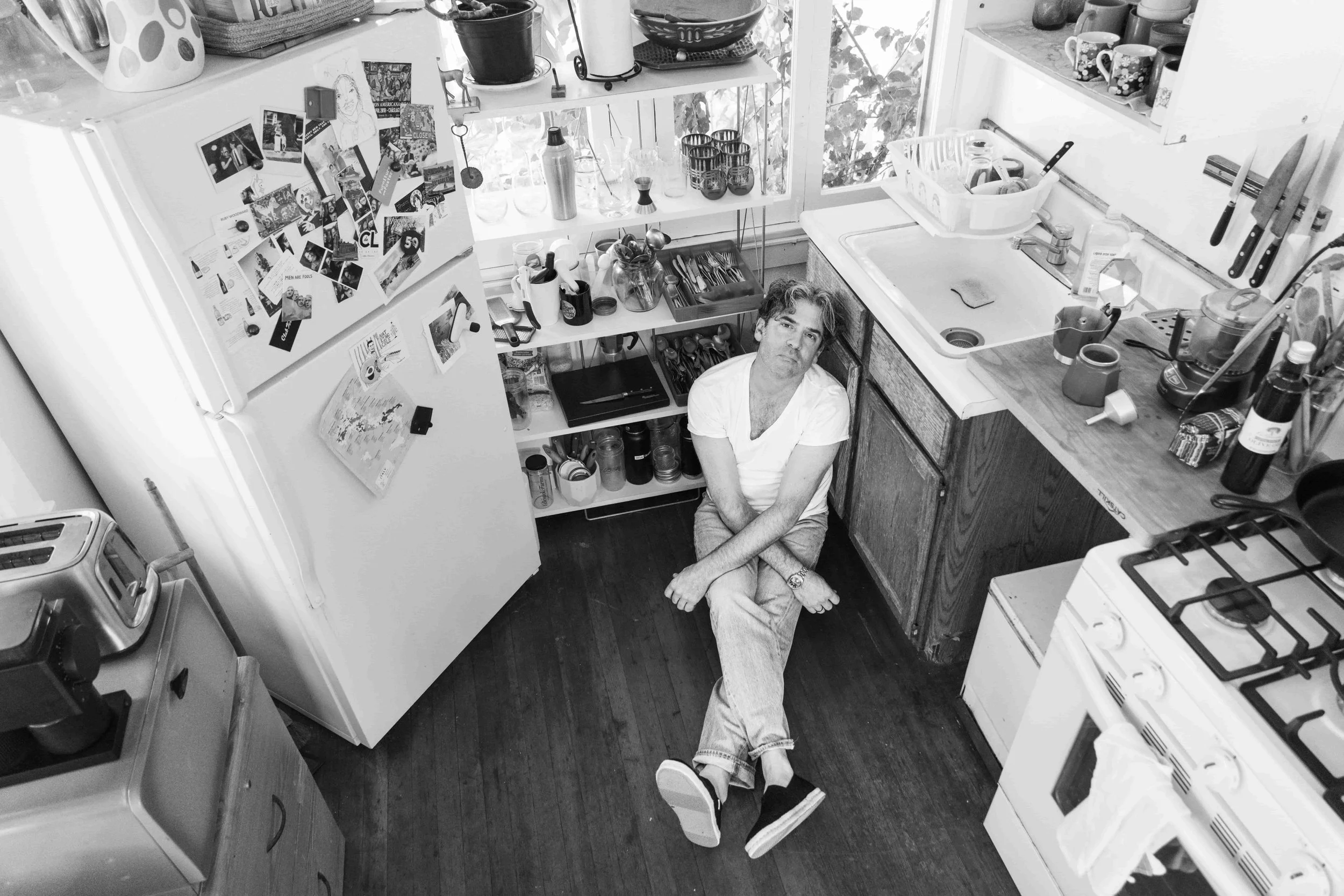
photo by Myriam Santos
Bassist and singer-songwriter Kimon Kirk’s new full-length double LP, Bikini Jardine, is slated for a summer 2026 release, following his release of Altitude in 2021. Bikini Jardine (whose title is a mashup of the name of the all female punk band Bikini Kill and the Beach Boys’ guitarist Al Jardine) includes songs written with Aimee Mann, alt-country icon Robbie Fulks, and Treat Her Right’s David Champagne, and features guest appearances by Mann and Gaby Moreno on vocals and NRBQ keyboardist Terry Adams on clavinet, as well as backing from Kirk’s longtime bandmates on the east and west coasts. Based in Los Angeles but raised in the fertile musical ground of Boston, Kirk has been the bassist in Grammy-winner Gaby Moreno’s band since 2016 and frequently collaborates with Aimee Mann as bassist, backing vocalist, and co-writer. He has also performed as bassist and harmony vocalist with Van Dyke Parks, Grant-Lee Phillips, Alejandro Escovedo, Rufus Wainwright, Session Americana, Amy Correia, and Sarah Borges.
Kirk’s brand new single, “Dashboard Hula Doll,” was written with the pioneering alt-country artist Robbie Fulks and includes a video shot in the Southern California desert. Kimon and Robbie met in Los Angeles after they were introduced by their mutual friend Duke Levine, lead guitarist for Bonnie Raitt, and a musician with whom both Fulks and Kirk had performed on multiple occasions over the years. The single was recorded at Sunset Sound in LA in one live session and features Kirk on vocals and electric guitar, Fulks on vocals and acoustic guitar, Levine on lead guitar, and the powerhouse rhythm section of Paul Bryan (Aimee Mann, Jeff Parker) on bass and drummer Jay Bellerose (Robert Plant and Alison Krauss), both of whom had anchored Levine’s band in Boston in the 1990’s and also comprised Dennis Brennan’s all-star group the Iodine Brothers. The blistering rocker chronicles the tale of a desperate man on the verge of losing everything – everything except for his guiding light, the grass-skirted hula doll that is perched atop the dash of his family car. Pathetic? Perhaps. But in the vein of John Updike, one of Kirk and Fulks’s mutual literary heroes, the story unfolds over two careening minutes and humorously evokes the downward spiral of one of Updike’s hapless male protagonists of yore. “Dashboard Hula Doll” also pays tribute in spirit to another of Kirk and Fulks’s heroes, beloved NRBQ guitarist Big Al Anderson, whose tongue in cheek compositions and ferocious guitar playing clearly informed the mood of the recording.
Bikini Jardine’s sprawling and homespun-but-high fidelity atmosphere was the result of an unusually productive writing period during the pandemic. With live performances curtailed for nearly two years, Kirk began writing and playing guitar in earnest at his home in Los Angeles, and a 15-song album took shape more quickly than any of his prior three albums had transpired. Some of the two volume LP’s songs are among the quietest Kirk has recorded and are largely acoustic with layered vocals; others qualify as the heaviest music he has committed to record, with aggressive and distorted guitars, loud and lurching drums, and chaotic keyboards all part of the mix. Many of the lead vocals were cut live with the band while the takes went down; a handful of the recordings were made by Kirk alone, performing and layering vocals and instruments one by one. The songs frequently reference the locales near where they were written: the neighborhoods around the east side of LA near Kirk’s home, an abandoned 19th century barn in a field in Massachusetts, a small apartment on Lake Como in northern Italy. Kirk cites the Beach Boys’ Friends, double albums by the Beatles and Rolling Stones, Stevie Wonder’s Music of My Mind, the first Paul McCartney solo album, XTC’s Apple Venus volumes 1 and 2, and Marisa Monte’s Infinito Particular, along with the work of Gabriel Orozco, Beatriz Milhazes, and Ray Johnson, as constellations of reference for Bikini Jardine. Inspired by such topics as visual art, geography, friendship, culinary epiphany, lost love, and class dichotomy, Bikini Jardine paints a sonic landscape grounded in humanity and in-the-moment musical interplay, and whose songs’ shambolic cohesion grapples with the vagaries and complexities of 21st century life.
“Kimon Kirk can nail longing and regret and an existential shrug all in one lyric. His music makes me restless, makes me want to put down whatever book I’m reading and go out in the world to see what I’m missing and he’s not.” — Maureen Corrigan (NPR)
“Exceptionally strong pop songs, often with a reflective slant, but with the irrepressible feeling of the best power pop.” — Heaven Magazine, Netherlands
“In a world in which masterful melodic songwriting and rich, understated production were king, philosopher-poet Kimon Kirk would rule with a velvet fist. Beautifully crafted pop in the Wilson-McCartney vein, via Andy Partridge.” — Alex Rubens (Key & Peele, Community)